Kervano Pest Defense GroupKervano Pest Defense Group

Subterranean Termite Soil Barrier & Trenching Treatment

South Texas coastal humidity and high water tables create sustained pressure from subterranean termite colonies. In neighborhoods like Kings Crossing, South Side, and Gardendale, sandy clay loam retains irrigation and…
Call (361) 585-4030 →(361) 585-4030
Subterranean Termite Soil Barrier & Trenching Treatment in Corpus Christi, TX
Quick answer
  • What's included: Continuous perimeter trench excavation, sub-slab foundation rodding, backfill treatment with non-repellent termiticide, and post-application ground restoration.
  • Response speed: Local technicians dispatch for on-site structural foundation evaluations within 24 to 48 hours across the Corpus Christi area.
  • Cost structure: Complete home perimeter barriers typically range from $850 to $2,400 based on linear footage, with targeted spot treatments starting at the $250 service minimum.
  • Target pests: Eastern subterranean termites and Formosan subterranean termites attempting subterranean entry through slab cracks, expansion joints, or plumbing penetrations.
  • How to book: Call (361) 585-4030 to schedule an on-site perimeter linear-foot measurement with transparent upfront pricing and no mandatory long-term contracts.

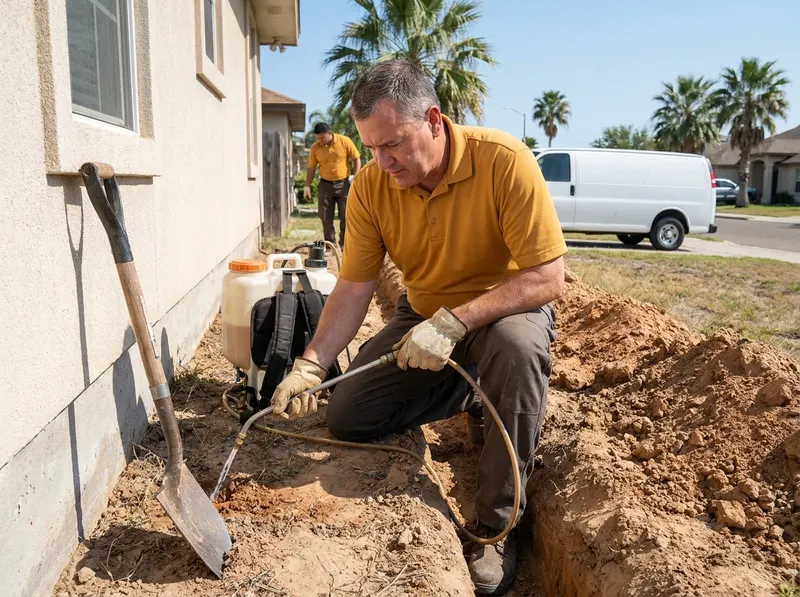
South Texas coastal humidity and high water tables create sustained pressure from subterranean termite colonies. In neighborhoods like Kings Crossing, South Side, and Gardendale, sandy clay loam retains irrigation and rainfall, creating optimal subsurface foraging corridors around concrete foundations. A soil barrier and trenching protocol addresses this structural vulnerability by creating an uninterrupted band of treated earth around the entire foundation grade beam. Technicians excavate a shallow trench measuring roughly 6 inches wide by 6 inches deep along exterior walls, inject a precision-calibrated liquid termiticide into the trench floor using pressurized rodding equipment, and treat the backfill soil as it is returned to the trench.

Trenching and soil barrier applications provide immediate, continuous perimeter defense compared to subterranean bait stations alone. While bait monitoring systems rely on foraging termites stumbling across plastic stations spaced several feet apart over several months, a continuous soil barrier forms an impenetrable protective ring around your foundation immediately upon application. For properties in Calallen, Flour Bluff, or older slab homes in Del Mar exhibiting active mud tubes along exterior grade beams, liquid trenching stops active subterranean entry instantly. The trade-off involves minor physical disruption to exterior mulch beds, soil lines, and the necessity of drilling small holes through adjoining concrete patios to treat the soil underneath.

Modern non-repellent termiticides bind tightly with soil particles, preventing migration or leaching into nearby coastal waters such as Oso Bay or Corpus Christi Bay. As subterranean termites tunnel through the treated barrier zone, they cannot detect the active ingredient; they contact it, transfer it to nestmates through social grooming, and eliminate the broader colony network. Once backfilled and tamped down, the soil barrier remains locked in the substrate beneath the surface, presenting no airborne exposure and keeping indoor spaces completely free of chemical odor.

What it costs

Targeted Foundation Void & Partial Perimeter Treatment$350 – $650
Standard Residential Perimeter Trenching (150–200 Linear Ft)$850 – $1,650
Large Footprint or Complex Foundation Barrier (200–300+ Linear Ft)$1,650 – $2,400
Minimum Spot Soil Barrier Application$250 – $350

Every job gets a firm, written price after a free on-site visit.

Common questions

How long does a subterranean termite soil barrier & trenching treatment in Corpus Christi last?
A professionally applied liquid soil barrier typically provides continuous subterranean protection for 5 to 8 years in South Texas soil conditions, depending on local rainfall, moisture exposure, and subsequent landscaping disturbances.
Will trenching for subterranean termite treatment disrupt landscaping around Corpus Christi homes?
Technicians dig narrow 6-inch trenches immediately adjacent to exterior grade beams, carefully setting aside top mulch, pea gravel, or turf before replacing and tamping down the soil to leave flowerbeds intact in neighborhoods like Bay Area and Annaville.
Is subterranean termite soil treatment safe around children and pets in Corpus Christi?
Yes, the non-repellent termiticide bonds directly to soil colloids underground and remains buried beneath the surface, eliminating surface contact risks once the trench is backfilled.
How does Corpus Christi coastal soil affect trenching barrier performance?
Nueces County soils vary from dense clay to loose sandy loam, which requires specialized injection pressures and rod spacing to ensure uniform product saturation without creating untreated gaps.
Do I need a mandatory recurring contract with a subterranean termite soil treatment in Corpus Christi?
No mandatory recurring service contract is required for a subterranean soil barrier treatment; it functions as a standalone long-term protective installation, with optional annual warranty inspections available upon request.

Ready to get started?

Tell us about your subterranean termite soil barrier & trenching treatment job in Corpus Christi and we'll send a clear, written quote — usually the same day.